
Watching Baseball

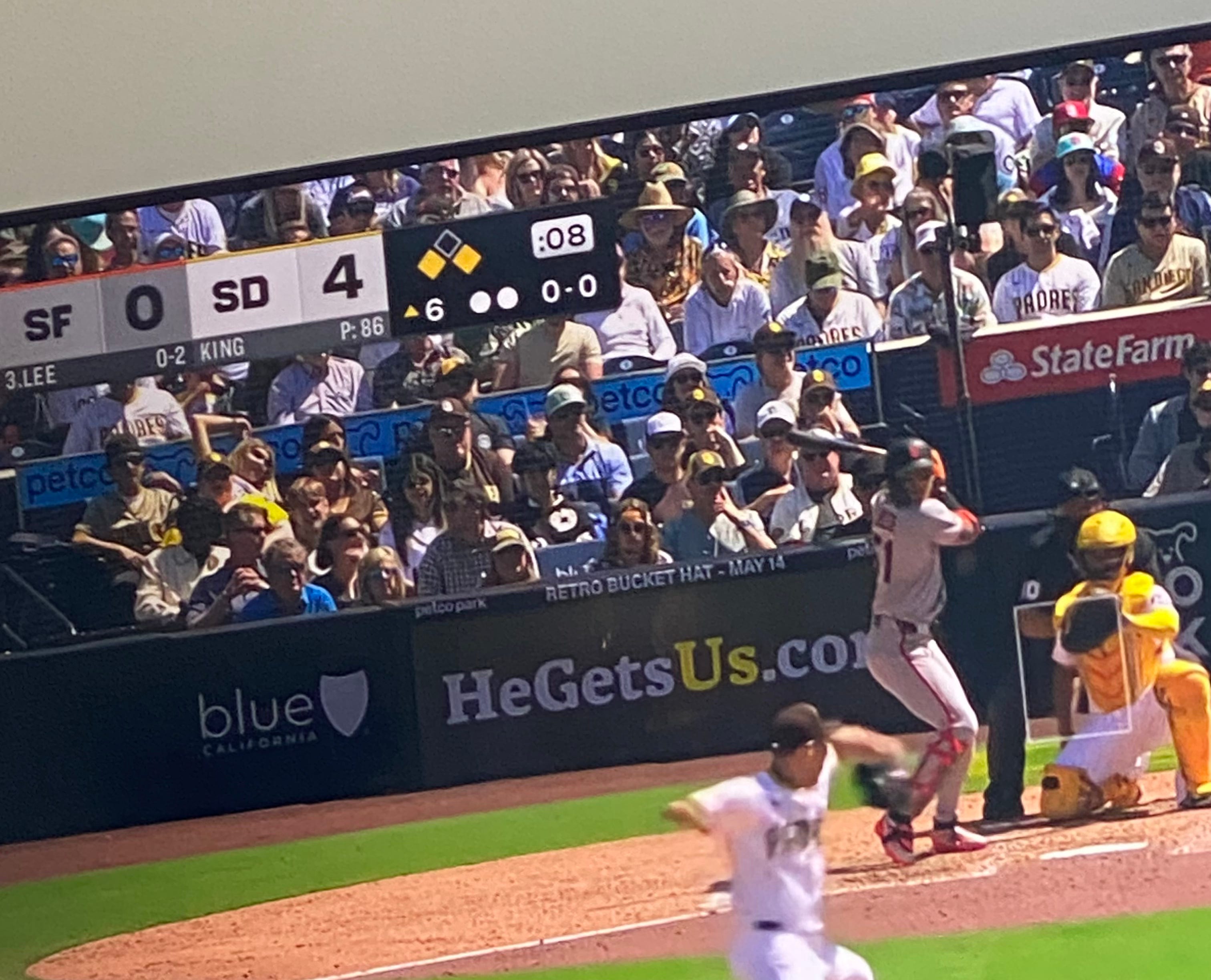
I used to joke that if I’d used the time I spent watching baseball as a kid for literally anything else I could have become some sort of child prodigy. If I’d stuck with those piano lessons, for example, despite the odorous teacher and her demon dog — a story for another day — I surely would have reached 10,000 hours by early adulthood. I could be playing Carnegie Hall. Instead, I’m the friend at the baseball game who answers all the questions about foul tip strikeouts and the infield fly rule.
It seems that baseball is experiencing something of a comeback. I overheard more chatter about Opening Day 2026 than in years past, I think in part thanks to a slew of recent rule changes and a very exciting World Baseball Classic that, as great sporting events can do, provided a certain catharsis by reflecting and inverting a geopolitical struggle on the world stage, with Venezuela defeating the United States in the championship game.
I have tried to “get back into baseball” for a few consecutive seasons now. I grew up playing baseball, watching baseball, and reading about baseball, but as I grew older and busier it faded from my daily life. I always viewed this as sort of inevitable. What kind of adult has the time to deeply follow a sport that’s happening nearly every day for three hours at a time? Like video games and tetherball, I came to regard watching baseball as a childhood triviality that I had, as part of the natural maturation process, simply outgrown. But on some level, I felt the loss. And its absence gnaws at me now more than ever.
I think my desire to reconnect with baseball speaks to a certain longing for less, to use Kyle Chayka’s phrase. In a world of increased complexity, rapid change, and political chaos, baseball is an exercise in stillness. Yes, the league took some steps to clip the length of the game, but actually watching baseball still looks a whole lot like, well, nothing at all.
For me, baseball is connected to another ritualized and nearly-extinct activity – reading the morning newspaper. My dad taught me to parse the standings in the Sporting Green section of the San Francisco Chronicle when I was 5 or 6, and I would open to those neatly-formatted divisional rankings every morning, studiously tracking the progress of my first favorite team, the team I was on that year in little league: the Chicago Cubs. They were terrible that year – this was 1996-1997 and they finished dead last in the NL Central. At that age, I didn’t quite grasp the pacing and the mathematical realities of the baseball season, and I would naively flip open the Sporting Green each morning, hoping to discover that the Cubs’ prospects had significantly improved overnight. Eventually, I grew to learn those indispensable traits of sports fandom — the patience, acceptance, and forgiveness required to hope desperately for something despite a full awareness of its implausibility. The emotional capacity to tolerate unrequited love is the inevitable obligation of any true sports fan.
Last week, I decided to participate in a 7 day free trial of MLB.TV, so that I could stress test my new intention to reconnect with baseball, and specifically my beleaguered San Francisco Giants (my brief early Cubs fandom had transformed into a preference for the hometown squad as my young brain ripened). I had been following the Giants’ season for the first 10 games. Things were not going well. They were tied for the worst record in the entire league, had given up the most runs per inning of any team in the league, and the previous night their flailing bullpen had blown a 4-0 lead to the Philadelphia Phillies, resulting in a 6-4 defeat and bringing their win-loss record to an ominous 3-7. And yet, I was excited to watch. Maybe this is just a bad start! The season is young. A lot of our best players are just slow out of the gates. These are the self-soothing bromides of a fan in denial.
I flipped on the game and was greeted with the familiar banter of longtime Giants broadcast announcers Mike Krukow and Duane Kuiper – or “Kruk and Kuip” as they are so nicknamed. One of the great things about local broadcasting is that, unlike the sport itself, it is not a young man’s game. As beloved players pass through a fan’s life like months of a calendar year, the broadcast crew remains constant as an old friend. The legendary Dodgers announcer Vin Scully called games until he was 88 years old. And watching or listening to baseball fosters a particular intimacy with the announcers. Baseball is a slow game, and there is plenty of empty air to fill with statistical analysis, perfunctory repartee, and philosophical reflections on the nature of life itself. When I started watching Giants games as a child, Mike Krukow and Duane Kuiper were about 45 years old. They are now 74 and 75, respectively. These people have been in my life as long as the members of my own family.
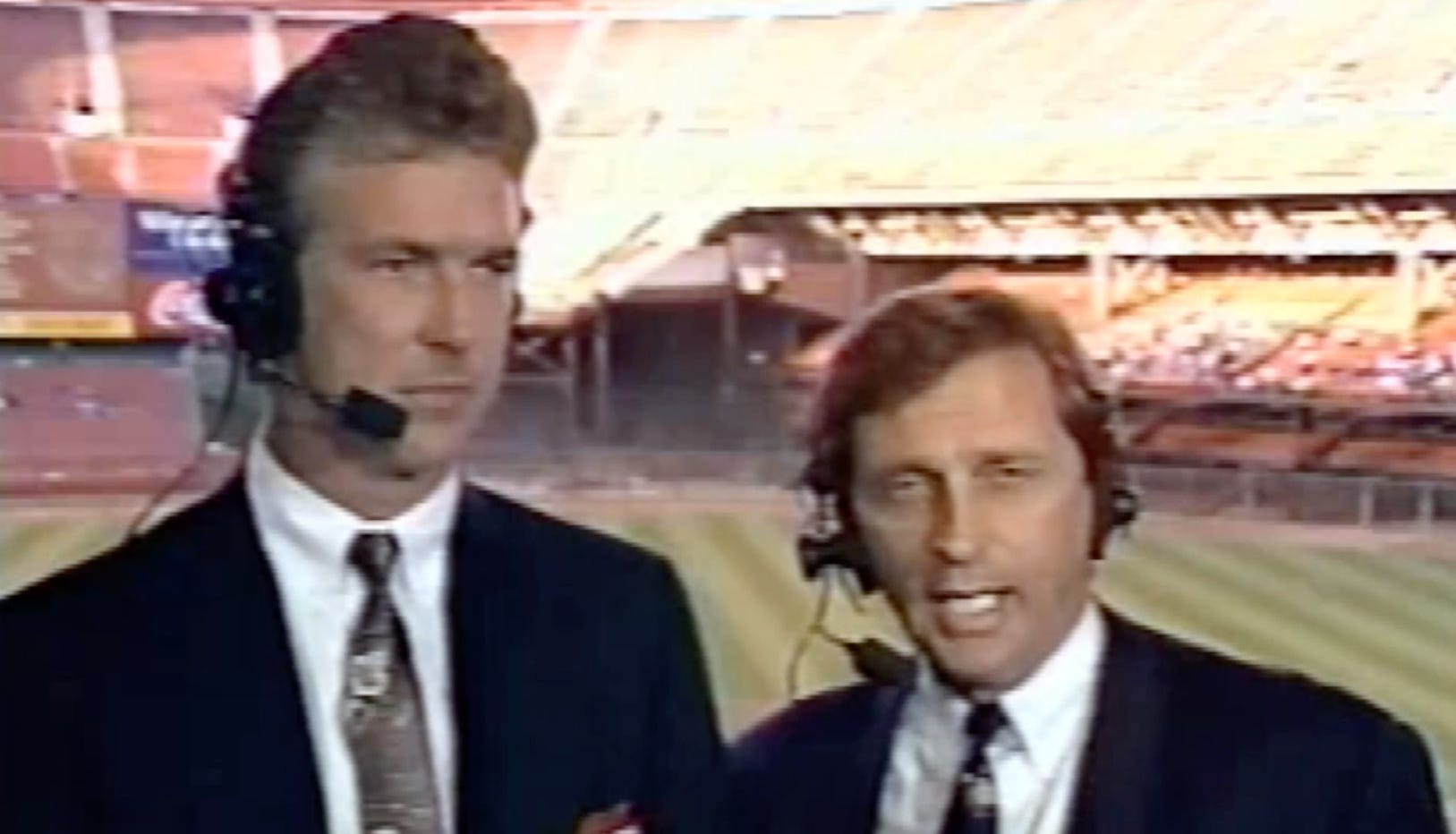
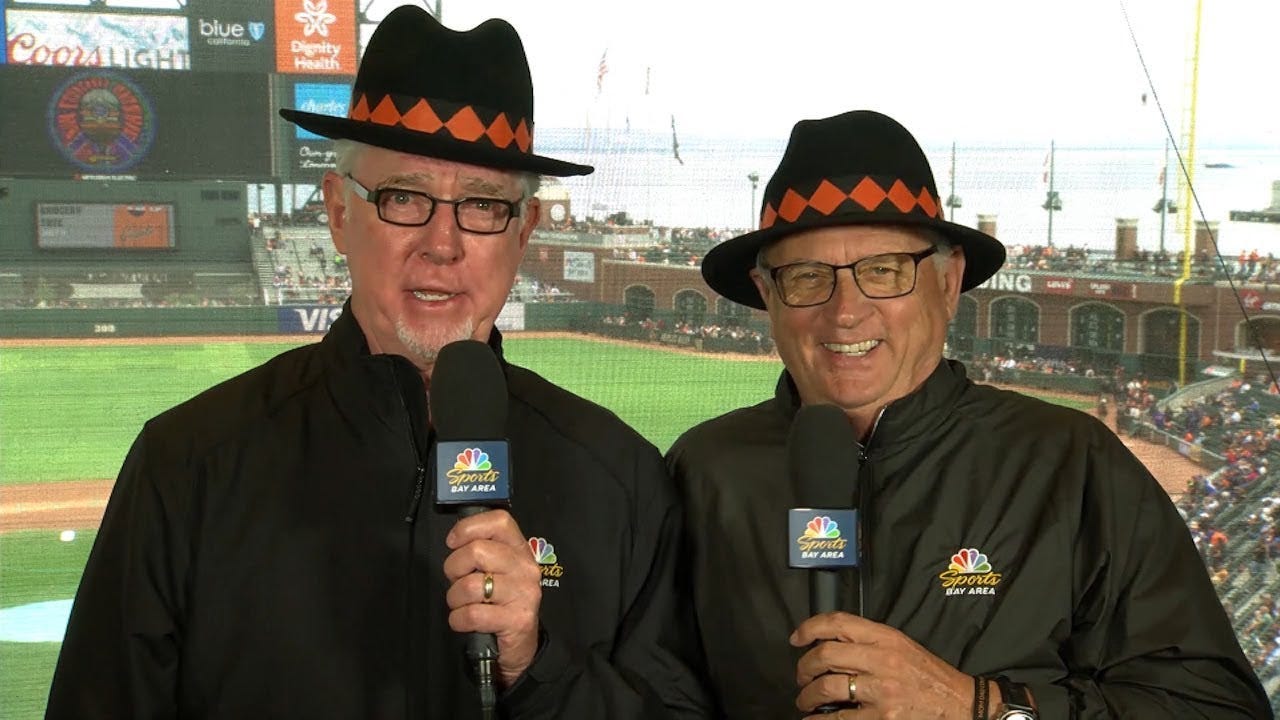
Now a 35-year-old sitting on my couch in Brooklyn, I drifted into a Proustian reverie listening to Kruk and Kuip murmur between pitches and exclaim when there was a hit. How many hits and runs had they seen over the course of 30 years of broadcasting? How excited could they actually be? Perhaps they cared just as much as the first time, or not at all. Maybe it varied depending on the day. This is their job, after all. The Sisyphean act of baseball broadcasting reflects adult life itself.
But abiding by Camus’ exhortation, I found pleasure in the banality rather than despair. Here was a team that wasn’t even doing very well, and here I was watching them. Together, despite the circumstances, something was created – a relationship was brought back to life. Did it really matter if the Giants were winning or not? The joy is in the striving, and the particular details of the experience.
Baseball, more than any other sport, favors these small traditions that are at once rote and meaningful. There exists in the collective consciousness of player and fan a constellation of “unwritten rules” — social mores governing both the way the game is played and the experience of watching it. These are the sinews that bind the experience across time, space, and language. The commissioner can change the size of the bases, but formal rule changes will never alter the etiquette of baseball — the way the umpire will delay play by meaninglessly dusting off home plate if a catcher suffers a painful-seeming foul tip to the body; the melodramatic posturing of a batter who’s been knocked to the ground by an errant pitch; the way the crowd boos if the pitcher tries to pick off one of the home team’s runners; the spitting.
The Giants had scored a run. I tempered my excitement with something like self-protective cynicism. The psychology of fandom kicked naturally into gear. Like any long term relationship, watching baseball offers consistency in exchange for imperfection. There wasn’t much to do but sit back and take it in. Here are a few things that happened within the first 30 minutes of me turning on the game:
Kuip hiccuped audibly into the microphone shortly after the broadcast returned from commercials. I waited for a minute in the silence that followed to see if he would acknowledge the spasm. He did not.
The broadcast attempted to show a replay, but the booth cued up the wrong clip and so we watched an irrelevant pitch unrelated to the point the announcers were trying to make. After it finished, Kruk paused awkwardly and said, “Maybe not.”
Out of the blue, Kruk and Kuip referenced a 2007 game that I remember watching live from my childhood home, in which third baseman Pedro Feliz was forced to perform catching duties due to injuries to the other two rostered catchers.
The cameras cut to a kid in the stands bouncing around in a Philly Phanatic outfit while his dad scooped kettle corn with a giant paw in the seat next to him. Baseball broadcasts capture family life in miniature better than any other American media.
As I watched the Giants starting pitcher Robbie Ray make his way through the top of the 2nd inning, the camera panned to the Phillies dugout. Standing there, hunched over with his hat pulled low over his eyes, was Phillies manager Rob Thomson. His outstretched arms were perched atop the dugout railing, hands dangling lifelessly. He looked pained, like a guy with a bad back waiting for a prescription refill at the pharmacist. Kruk and Kuip referred to him with the endearing sobriquet of “The Skipper.” The nautical analogy rang true. My mind drifted to Moby Dick, which I happen to be slowly reading – watching the nation’s great pastime while reading the nation’s great book. The two activities seem to go well together. Maybe it had something to do with the water, the waves. All of a sudden, I felt silly about my joke about not becoming a child prodigy. It’s possible watching all that baseball provided me with a different set of benefits. The skipper spit some seeds. The kid in the stands rolled in his seat and angled his head towards his dad. The baritone drawl of Kruk and Kuip washed over me as I sank softly back into my couch and sighed. Foul ball. The batter stays alive.
Absolutely fabulous post, sir! Lovely ruminations on Our Game. And if it's any consolation, our Richmond Squirrels (your AA farm team) is tearing 'em up and also debuting their brand-spanking new stadium. Come watch a game with me someday