
My weekend in Crossworld
Ambition and bonhomie intermingle at the 48th annual American Crossword Puzzle Tournament

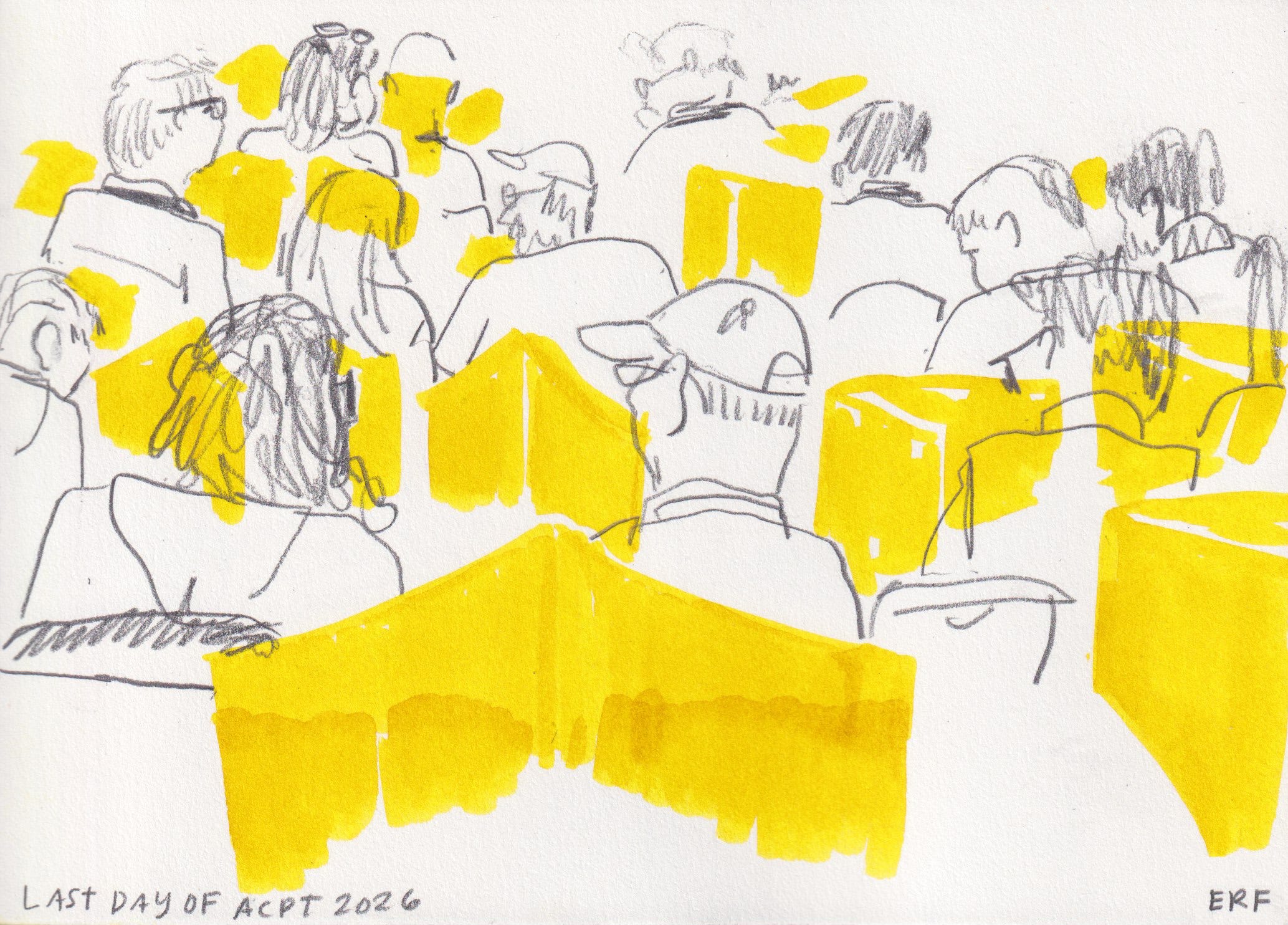
Last Wednesday my friend Adam, a crossword enthusiast, invited me to tag along to the upcoming American Crossword Puzzle Tournament (ACPT), a competitive convention that he would be participating in for the second consecutive year. He actually invited me last year too, but due to the fact that I don’t do crosswords, and to the unfortunate but unavoidable conflict I’m pretty sure I actually had, I hadn’t taken him up on the offer. But this year’s conditions were different. I was now on a “self-directed work sabbatical,”1 I had just churned out an essay about baseball that I took great pleasure in writing, and I was flush with the particular excitement derived from combining whimsical intrigue with the self-reflective practices that this medium affords. I figured a crossword puzzle tournament would be an interesting thing to scrutinize. More than anything, I wanted to understand what these people got that I didn’t.
I am not a puzzle person. I attribute this to my childhood, which was lovely and edifying in many ways, but did not feature many wholesome gaming experiences. My most vivid game-related family memory is of one night when we tried but failed to play Monopoly because each time it got to my dad’s turn we looked up to discover that at some point he’d simply gotten up and wandered from the room. Eventually, we moved on to another activity. Even now, I’m not keen to participate in a “game night” at a friend’s place. I do not have the NYT Games app on my phone. But I was intrigued by the opportunity to observe, and sensed I might glean something from a weekend spent swimming in a sea of crossword devotees.
After a cursory search of the ACPT website, Adam and I determined that there wasn’t a way to attend the event in a purely observational capacity. I asked him half-jokingly if I could gain access as an “independent journalist,” and he forwarded me the email address of Michael Smith, one of the event coordinators. I reached out, expectations set appropriately low. Pretty quickly, I received a response: “You will be welcome at our event. I’ll ask for a badge be prepared for you for Saturday morning.”
I picked Adam up on Friday afternoon and we wound our way up and out of New York City towards Connecticut. In the car, I probed him with questions about crossword puzzles, the tournament rules, and the community at large. I was determined to find patterns among the crossword solving set. What type of person chooses to participate in an event like this at not insignificant personal financial cost (a competitor ticket is $275, and the Marriott hotel rooms are about $400 total if you stay for the whole weekend)? I conceded to Adam my presumption that crossword puzzle hobbyists are classically nerdy types, and joked that I expected to see a lot of “pocket protectors.”2 But I wasn’t really sure what was in store for me. Until last weekend, Adam was the only person in my life that I knew regularly solved crossword puzzles, much less for speed.
Driving along I-95 on our way into Stamford, Adam outlined for me a few important details:
The “solver” is the person completing the puzzle and the “constructor” is its architect.
The ACPT is the oldest and most established annual crossword puzzle gathering (though Boswords and Lollapuzzoola are two others that occur regularly).
Tournament action is divided across Saturday and Sunday, but Saturday is when the majority of the puzzles are played.
Solvers are broken out into Divisions A-E based on experience and skill level. The top three finishers in divisions A-C compete in a live playoff that takes place Sunday in the main ballroom of the hotel, while everyone else spectates and a play-by-play is conducted over the PA system.
We arrived at the Marriott on Friday evening, in time for a wine and cheese event hosted in the hotel lounge area. I found myself struggling to get a sense of the vibe. Based on the set and setting, I felt like I was at a convention or a company offsite. But solving crosswords is a hobby. How seriously were people taking this? Was this business or pleasure?
Adam introduced me to a number of people, many of whom had traveled from out of state to be there. The lines for the drinks were long. People were obviously here for a good time, and although I drank lightly I noticed those around me going back for seconds and thirds of the pinot noir on offer. I started to loosen up and enjoy myself. I took out my camera and snapped a few photos. After a couple hours of friendly mingling, we headed upstairs to our room.
I didn’t sleep very well that night. Somewhere between Long Island City and the New England Thruway, I’d gotten embroiled in a personal drama that was straining my nerves. A brief romantic relationship had ended, and I was attempting to resolve a conflict over text message. I was being asked a series questions I felt I could not answer. My ability to articulate and communicate my feelings, even to myself, was faltering. I longed for clarity, but the harder I pursued it it the foggier things became. Lying on the bed, I stared into my phone, trying to find the words that would land this exchange on something like a resolution. But they wouldn’t materialize. I spent the night asking myself questions that didn’t have answers, turning them over and over in my head.
In the morning, we settled our stomachs with the hotel breakfast while waiting for the games to start, and the lobby slowly filled up with solvers. I soon came to appreciate the popularity of this event. The ACPT has grown steadily since its inception, and will be moving to a new location in Philadelphia next year to make room for even more participants. When registration for 2026 opened in January, tickets sold out in 1 minute and 37 seconds. The wait list was also soon full. The main ballroom could seat ~800 solvers, and there were overflow rooms downstairs to accommodate the rest.
I initially assumed that being good at crossword puzzles correlated to an expansive trivia knowledge. I hypothesized that being older, with more lived experience, might confer benefits. After chatting with solvers and surveying the crowd, I was quickly disabused of these notions. Age doesn’t seem to matter much. (The two-time defending champion was a young man in his 20s named Paolo Pasco.) If anything, youth might provide an edge. Solvers are graded on completion, accuracy, and speed, and what separates the great from the good appears to be some combination of puzzle experience and physical prowess. The top solvers have solved so many crosswords that they have a developed an intuition about what words are most applicable in various grid arrangements. It’s not necessarily that they know a lot of facts (although they do), but more that they know how those facts slot into the geometry of the crossword object. Once knowledge is total, performance comes down to physical speed and agility. The top finishers were solving crossword puzzles in 4-5 minutes. Their pencils barely left the page until they were done.
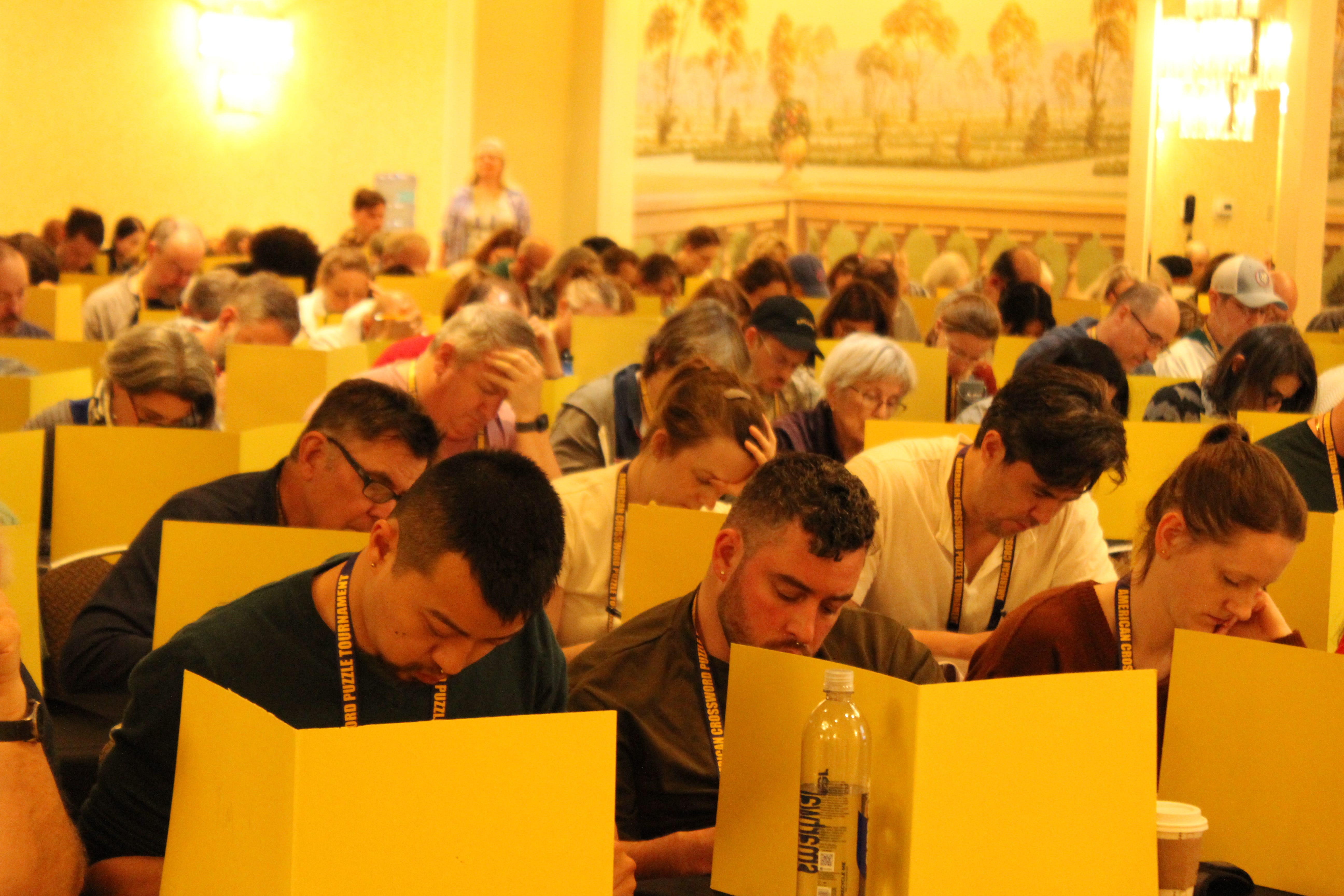
Eventually, we found our way into the main ballroom, where Puzzle 1 was set to take place. Tables were arranged in rows, set with yellow dividers to deter wayward eyes and adorned with name tags, some artfully personalized. I took my seat at the outer edge where seating was reserved for non-competing participants and event coordinators. As far as I could tell I was the only “media” person there. I’d heard someone from Slate was covering the event, but I never met them. There were people with much more legit setups racing around the room capturing video for what I assumed were official ACPT purposes. I smiled to myself, and stood up to take a few more photos.
Soon, Will Shortz took the stage. Shortz is the Crossword Editor at The New York Times and the Elohim of Crossworld. In 1978, at the age of 25, he held the first-ever ACPT and has been its director ever since. He welcomed the puzzlers and talked briefly about the history of the tournament. He highlighted the number of participants and diversity of ages represented (the tournament’s youngest solver was 17 and the oldest was 100). Shortz is clearly beloved by the community and was adept in his role as MC. In his introduction, he mixed personal reflections with poignant community highlights. He gave an update on his recovery from a stroke he’d suffered a few years prior, and was met with supportive applause. He presented a bouquet of flowers to ACPT’s “first centenarian,” a woman named Miriam who’d won the second-ever tournament in 1979. He made a self-deprecating joke about how “moving quickly” was a “stupid clue” for ARROW, which I didn’t understand at the time and I don’t understand now.
“Ready…set…GO!” On Shortz’ call, and with a collective whoosh!, hundreds of papers flipped, heads bowed, and the first puzzle had begun. I was immediately flushed with the sense memory of a high school exam room. Sitting on the edge of the ballroom arena, I scanned the crowd. It was dead silent. Beneath the jocularity of ACPT was a clear competitive substratum, and it had now emerged. Games require both personal ambition and collective goodwill. When transposing an individualized leisure activity into a tournament environment, you must contend with the tension that emerges from these opposing forces. To enjoy the experience, you have to be able to toggle between what philosopher C Thi Nguyen describes as the goal and the purpose. “When you have your friends over for a night of cards, the goal is to win, and the purpose is to have fun,” says Nguyen, quoting philosopher Barbara Herman. Perhaps my issue with games is that I find it difficult to navigate this tension. With friends, I’d rather participate in the “infinite game” of conversation. I don’t like to be competitive at close range.
But it wasn’t like I didn’t have goals of my own. Here I was, media badge printed with the name of my Substack and an entry-level DSLR camera dangling from my neck, chatting up strangers and scribbling notes like I was on assignment from Harper’s. Like the puzzles, my self-designated role for the weekend was blessedly clear-cut. It’s liberating to immerse yourself in something with clean edges and clear expectations, even if arbitrarily. I had to acknowledge that I was here for a specific purpose, and that giving myself this half-serious mission of “independent journalism” was motivating and fun. More than anything, it took my mind off my more muddled real life affairs.
When the first three puzzles were over it was time for lunch. Adam found some people he knew and we fell in with their group as we made our way gingerly across wide avenues to the main stretch of town where the majority of restaurants were located. By the time we got to the place, we didn’t have much time to eat. The second round of puzzles would be starting soon, and — though not far — it took about 15 minutes to cover on foot in this pedestrian-hostile downtown area. We were an unwieldy group and figuring out our seating arrangement at the restaurant proved difficult. IQ levels are immaterial, it seems, to that most familiar task of finding consensus in a large party while juggling competing preferences, social etiquette, and hunger levels. Urgency was high, but not everyone knew each other very well, so people were keeping a lid on things while clearly trying to ensure that they wouldn’t miss the start of the day’s second half.
I found myself at a table with a group of very nice and fast-talking people. The makeshift media badge was a different color than the standard participant badge, and this drew curious looks and sidelong glances all weekend (a population of puzzle-solving savants is perhaps especially attuned to a discrepancy). Lunch was no different. My poor sleep the night before had rendered me ill-prepared for the pace of the conversation into which I was being reeled. I did my best to respond to their questions about why I was there, test piloting a few themes that I thought could be interesting for the piece. I couldn’t help but feel insecure about my performance. Does solving crossword puzzles lead to increased verbal celerity, I wondered? If so, I might be spending the rest of the weekend as a wallflower.
Back in the hotel ballroom, I introduced myself to the man sitting next to me, who turned out to be a linguist from Brown named Scott AnderBois. He explained to me the work he’d done related to crosswords and the article he’d co-written for The Atlantic about how crosswords are essentially a language unto themselves, with specific rules like any other. This idea suggests that intuition plays more of a role in crossword puzzle solving than pure knowledge, and seemed to corroborate what I’d learned about high-level performance being less about trivia recall than fluency with the form. Puzzles are an essentially human activity because they leverage the human ability to play with language and associations.
Dr.Fill, an AI that recently achieved the impressive milestone of outscoring the human competition at the 2021 ACPT, illustrates where the science of crosswords diverges from the art. According to AnderBois, AI has achieved superiority at some aspects of solving puzzles, but it in a different way than by using what he called the “lateral thinking” of humans. In addition to simple factual answers (“2003 Grammy winner for ‘Little Things’”) crossword puzzles use themes and other mechanisms to present more of a challenge. For example, Puzzle 2 at ACPT required solvers to swap the names of capital cities in for homophones of that city name (“HAVANA GOODING JR” and “TBLISI OKEEFE”). AI is not good at applying this level of finesse, and seems to lack what I repeatedly heard referred to as “taste.” Dr.Fill is good at solving the puzzles but not constructing them in a humanlike way. Much has been written recently about whether AI has taste, and this seems to be another example of the technology’s inability to deliver that quality of real creativity that humans are so intuitively able to discern.
There’s also something revealing about a computer program solving a crossword puzzle — it of course misses the point entirely. A crossword puzzle is a facsimile of a real problem, the type we might want AI to solve for us in other, higher-stakes contexts. For Dr.Fill’s creator, the computer scientist Matthew L. Ginsberg, the problem to solve becomes the AI’s capabilities themselves. But for the human solver, the pleasure of crosswords comes from wrestling with a question until you find the answer. Clearly, solving puzzles has something to do with taking up arms against confusion and eventually achieving clarity. By eliminating it entirely, Dr.Fill serves to articulate the very purpose of a game.
My concerns about social isolation turned out to be entirely unwarranted. We had a great time that night with our newfound gang of merry pranksters, playing games, going to dinner, and hanging out in the hotel lobby.3 Like humans do, we formed connections around shared activities. I even waded into a few games myself, keen to work out my atrophied competitive problem-solving muscle. It was like trying to surf alongside Kelly Slater. The people I was playing word games with were some of the top verbalists in the country, after all. Still, I enjoyed myself. By the end of the night, I had the NYT Games app downloaded on my phone.
The next morning, we gathered in the lobby and set off one last time across the pedestrian desert to get some breakfast. Sitting around the cafe table awaiting our orders, I realized how quickly I’d fallen into communion with the denizens of Crossworld. I was still somehow under-caffeinated, but I now understood more about crosswords and could follow the general contours of the conversation, like an exchange student at semester’s end. On the way back to the Marriott, I listened to the crew riff on bits of word play about Roald Dahl, who’d come up when someone mentioned the recent Broadway show about his life. They were trying to fit the phrase “Roald off the tongue” into a puzzle. “Think of a name that’s a homophone of a past tense verb,” someone said. A specific goal with a broader purpose. I suppose you could have said the same thing about the breakfast.
When we reached the hotel, I went up to the room I was sharing with Adam to “type up some notes,” which was a thin cover for taking a break. I looked again at my phone, at a string of long texts that made the top of my head tingle with anxiety. I felt the fog begin to creep back in from the recesses of my mind. I flopped backwards onto the bed and closed my eyes. Head resting on the cool starched pillow, I felt I could lay there, supine, for the rest of my life. But then my phone pinged. It was Adam. The final playoff was about to begin downstairs in the ballroom. I remembered where I was, and why. The task was clear. I got up.
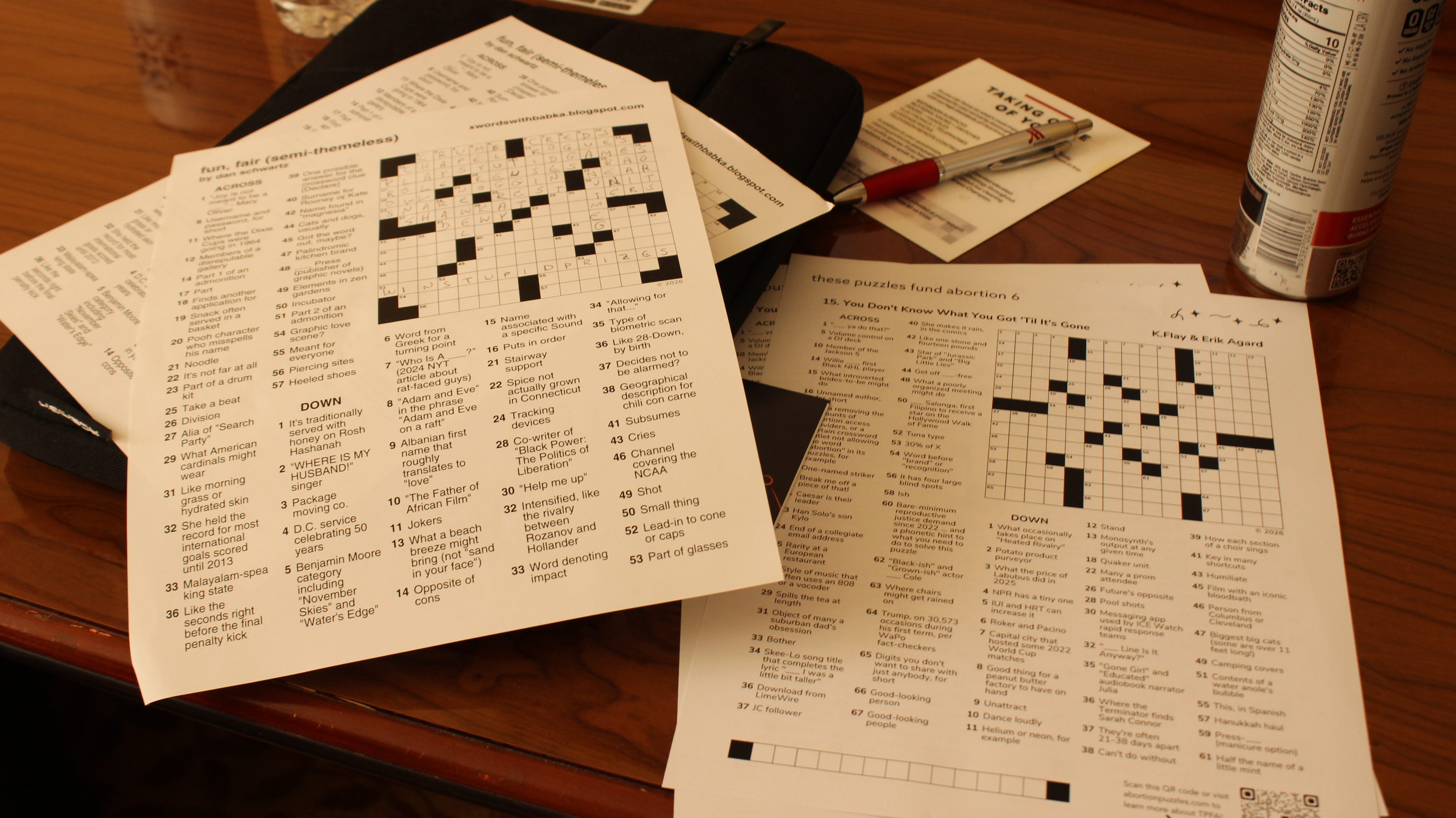
The phrase I’ve been using most recently
Admittedly, not my best work
Shout out to the lunch crew Finn, Josh, Kevan, Jack, and Emily